
Abstract
Traditional locative hypertext is highly reliant on fixed geographic locations: this allows stories to be tailored to those locations, but heavily restricts their audience. We present a novel locative hypertext system that dynamically positions and adapts narrative content to be responsive to any environment, an effect realised through integration of a pre-written narrative model with real-time environmental and location data. Initial user evaluations show that our approach achieves the traditional benefits of locative storytelling, including heightened perceptions and emotional connections that helped users see places in a new way. At the same time, we observe increased agency and a sense of freedom, leading to participants describing the experience as lived rather than read, with their agency arising through both narrative decisions and physical movement. Our work contributes a new model for locative hypertexts: a form of responsive digital storytelling that is location-considerate, yet location-independent; one which demonstrates many of the benefits of traditional locative hypertext, but with a new aesthetic of freedom and open exploration that fosters serendipity.
Introduction
Locative hypertext systems are a form of digital storytelling in which a narrative unfolds based on a user’s physical movement through space [9], typically through a location-aware smartphone. They represent an attempt to bridge the digital and the physical by enabling an embodied mode of reading that traditional literature cannot offer, where a user’s surroundings become an integral part of a narrative’s structure and delivery [13]. The defining characteristic of traditional locative hypertext is its capacity to foster deeper connections between readers and their environments through an inherent binding to pre-selected locations [7], yet this is also its primary limitation; the very essence of a locative story is to create immersive “place-bound literary experiences”[15], but a narrative that is meaningful only when accessed at a particular place necessarily excludes users who are unable to visit that location, either due to geographical, logistical, or socioeconomic constraints [9]. Consequently authors have diminished incentives to produce works with such a restricted reach. Our work thus starts with a provocation: what if a locative story could be read anywhere?
Digital locative storytelling takes the immediacy and agency granted to readers of Interactive Digital Narratives (IDNs) one step further, by asking its readers to stray from convention, wander outside, and take their story with them [9]. Careful design is required to balance users as they traverse and explore the liminal space between the real world and the fictional narrative [7]. Davies et al. argue that a locative approach to experiencing IDN is one that “[facilitates] a shared conversation between the reader, the printed page, and the environment” [3], promoting a novel kind of dialogue otherwise sitting beyond the reach of ordinary IDNs. In the opinion of Myers [20], a locative IDN is experienced by a reader with such active all-encompassing participation that she suggests their redefinition not merely as passive participants, but as “percipients” instead: individuals possessing the power to substantially direct a process through their “active, embodied and sensorial engagement”.
In the hypertext community, the best known locative hypertext system is probably StoryPlaces [11], an open source hypertext system built around the idea of sculptural hypertext. StoryPlaces requires a locative narrative author to structure their story as a node set mapped to defined areas: those nodes become available to read when both their logical and locative constraints are met. Many locative storytelling examples are situated at sites of cultural heritage, where the tight binding of story and place is crucial [16], but this limits the audience to those who can travel to that particular spot [4]. This limitation seems hardwired into discussions of locative hypertexts, although there are some systems that use alternatives to location triggers. For example, in StoryTrek[12] some story nodes are unlocked based on a reader’s pattern of movement (for example, backtracking, lingering, or leaving a path). Whereas in some works of Ambient Literature, such as Duncan Speakman’s It Must Have Been Dark by Then, the narrative is written to be ‘non-site specific’ leaving the reader to find appropriate places themselves in which to experience the text [22].
Perhaps the reason for the acceptance of this limitation is the idea that success depends on the interplay between place and story in creating a unified experience for readers, what Millard et. al call “Loco-Narrative Harmony” [18]. Any project intending to separate environment model (place) from story model (narrative) will face a significant challenge in managing this harmonic effect. Previous work has suggested intelligent generative hyper-structure as one answer to this problem [10] here text is anchored to location descriptions rather than specific locations, with an intelligent system proposed to select the most appropriate matching locations in the environment based on a number of heuristics describing how navigation paths and places should be chosen [21], however this system was never constructed or evaluated.
In this paper we present an alternative to either asking the reader or the machine to find a fitting location, one that gives the reader genuine freedom, and liberates a locative narrative from the confines of a pre-defined map making it available for a literal world of readers.
Overall Architecture
In our system, a user freely moves through a physical space and is provided with story content that responds to their context and environment. Like a traditional locative system the story content is in the form of short textual nodes stored in a Story Model. There are two processes in action: Dynamic Node Selection, choosing which nodes to present based on context, and Dynamic Content Provisioning, altering the text within those nodes based on context ^1. Our Context Model is itself made of up two components: an Environment Model that contains data about a user’s physical environment (terrain, coordinates, time, weather), derived using appropriate APIs to query live services, and Story State, data about a user’s interaction with the narrative itself (e.g. acts reached, scene history, or qualities developed). This Context Pipeline is shown in Figure 1.
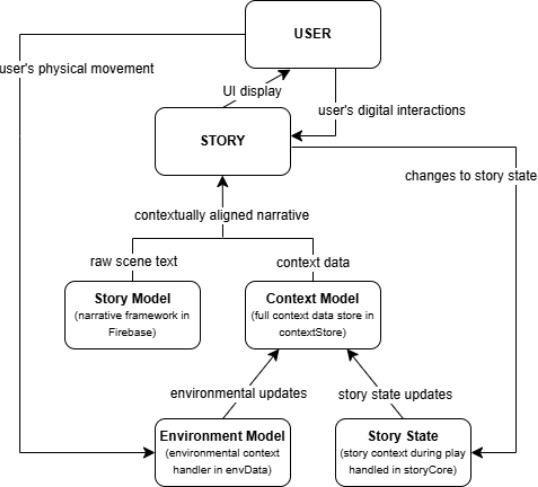
Figure 1: Interaction of Models in the Context Pipeline.
Dynamic Node Selection
Our Story Model represents the story data in the form of storylets, “discrete chunks of narrative” within a game’s structure [8]. A collection of storylets forms a sculptural hypertext [17]. Each storylet is an atomic unit of story selected dynamically based on the reader’s current context. Storylets are an effective model for locative narratives [11], but unlike systems like StoryPlaces, our system uses high-level storylets [17] that contain both content and branching choices. The effect is sculptural selection of a storylet, followed by calligraphic progression through its content, ultimately leading to alternative assertions that change the narrative state based on the reader’s choices. The mechanism behind the dynamic selection of these storylets involves a tiered filtering process with iterative refinement until a storylet is ultimately selected. This is a form of “salience-based selection” [14]; we are looking to pick a storylet that not only matches the current story state, but is closest of all available storylets to our context model. To do this, a query is run against a database collection containing the storylet index:
Storylets with constraints that match priority metadata are gathered in an initial query. For our example story (see Section 3), this was the current act, scene, and the type of terrain (defined broadly as ‘wild’ or ‘town’).
The results are then filtered based on the remaining story state within the context model: for instance, in our example story, when a reader is at the beginning of Act 3, the storylet presented to them must align with whether they acted bravely or cautiously during Act 2.
The set of storylets remaining at this point are those eligible both at this stage of the story and in this type of environment. This set is further refined; storylets with additional constraints (e.g. time of day) are potentially excluded, as are storylets that are similar to recently seen content.
Finally, we select those with any additional features that match the current context (e.g. ‘lake’ or ‘river’).
After this filtering process, the eligible storylets are returned to the frontend for rendering to the reader: if multiple storylets remain viable, one is randomly selected.
Dynamic Content Provisioning
Dynamic content provisioning is achieved at runtime via the substitution of placeholders in the narrative text with live contextual detail. This dynamic aspect enables complete integration of environmental context within the narrative. Our system enacts this by performing a sequence of contextual substitutions (based on data from the context model) on text within the storylet:
Complex placeholder tags have an id such as {{firstContext}} that maps to a list of possible textual replacements depending on the status of the context model.
Basic placeholder tags like {{time}} or {{season}} are replaced directly with values from the context model.
These are done in order, so that the text within complex placeholders can itself contain basic placeholders.
Figure 2 shows an example of two instances of the same scene in different reading contexts, resulting in the textual variation preceding “You hardly notice it. Your mind is quite elsewhere”. Both basic and complex substitutions occur in this example: the weather-related narrative description is a complex substitution, with a secondary (time-related) basic substitution embedded within.
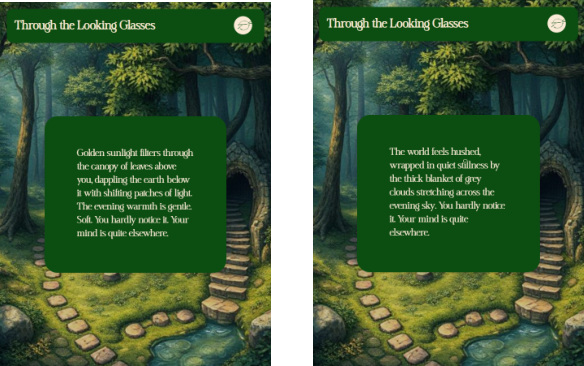
Figure 2:: Dynamic Content Provisioning
Through the Looking Glasses
We developed an initial story in the system to evaluate its effectiveness. The narrative follows a protagonist who finds a pair of spectacles that reveal a ‘magical’ world, rich with life and full of wonders. Their journey culminates in a twist: the spectacles are simply wire and glass, and the magic lies not in the glasses, but in the protagonist’s changed perception and awakened imagination. The story is approximately ten thousand words long, and around half is read in any one play session.
The final decision of the story symbolically asks whether the reader still needs the spectacles: in essence, asking whether they have learned to appreciate their surroundings without relying on the application as a guide. This design choice aligns with Mitchell’s concept of using game mechanics as experiential metaphors, where a player’s interaction with a game system mirrors thematic elements within its narrative[19]. In this case the reader’s actions, as they are aided by the application in the discovery of beauty in their surroundings, parallel the story’s themes of exploration and appreciation that surface as the protagonist experiences the magic of the world through the spectacles.
Evaluation
We set out to answer the research question: can a locative hypertext be dynamically fitted to a player’s space whilst maintaining the qualities of locative storytelling? Our methodology is a comparative study with a qualitative questionnaire. Both conditions used the same story and had the same look and feel.
Static Mode (SM) was a non-adaptive locative hypertext story where all the responsive elements were absent. Placeholders were removed and the sculptural storylet structure was replaced with a pre-determined set of encounters from which a reader had to explicitly choose. Readers still had to visit certain physical spaces during the experience, which ensured that it remained locative. Responsive Mode (RM) was the dynamic, adaptive locative hypertext story that employed DNS and DCP to evolve and tailor the story to a reader’s environmental context as they moved freely.
The ordering of modes was alternated across participants to minimize ordering influences, and the modes were blind. After reviewing safety guidelines participants engaged with the story independently on Southampton Common. The researcher observed from a distance, recording duration and distance walked. Following each narrative experience, participants completed a survey with 10 open questions designed to assess key themes concerning their experience of agency, immersion, enjoyment, connection with the environment, perspectives, and values. The research was approved through the University’s ethics process: ERGO/FEPS/102092.
In total, 9 participants (University students) took part in our study. We observed that RM sessions often lasted twice as long as SM sessions, suggesting deeper engagement: the average duration was 22.6 min in RM, and 11.73 min in SM. RM participants also walked further on average, reflecting greater physical exploration, suggesting that the perceived freedom of RM translated into actual exploratory behaviour: the average distances walked were 1.34km in RM and 0.69km in SM. Responses to the survey were inductively coded by the lead researcher and Table 1 shows the results. Theme names are based on the Responsive Mode (RM), but Static Mode (SM) quotes are included where it differed. For example, the theme of Surprise in RM was experienced as a lack of Surprise in SM.
Table — Themes and sub-themes from the qualitative analysis
Theme | Subtheme | SM | DM | Example Quotations |
|---|---|---|---|---|
Emotive | Surprise | 8 | 14 | “It didnt́ surprise me in the same way the dynamic one did – I saw what I expected to see.” (SM), “I laughed at the sheer serendipity” (RM) |
Playfulness | 5 | 22 | “Something was missing – the ability to go off and explore.” (SM), “[Wandering to find birds] was a delightful thing that I would never have otherwise done” (RM) | |
Awareness | Balance | 6 | 8 | “The logistics of it all dampened the magic of what I was reading.” (SM) |
Solutions to Imbalance | 1 | 3 | “Maybe an audio? Youŕe just replacing the sounds with sight.” (RM) | |
Deepened Perception | 11 | 25 | “I can’t ignore the birdsong, and I’ve started trying to find shapes in the shadows on the ground.” (RM) | |
Deepened Connection | 18 | 19 | “This experience invited me to make connections, and so it lent a significance to an otherwise unremarkable place.” (RM) | |
Freedom | Constraints | 23 | 1 | “I felt tethered to a specific path.” (SM), “It was nice that I didnt́ feel obligated to walk there” (RM) |
Exploration | 10 | 17 | “It gave me permission to go off the beaten track and discover things.” (RM) | |
Imagination | 5 | 17 | “I used my imagination less in this one.” (SM), “It was as if part of the story was written in the text and part of it was left up to me” (RM) | |
Choice | 16 | 26 | “I didn’t get to decide what was worth looking at.” (SM), “I felt a symbiotic relationship where it affected me, and I affected it.” (RM) | |
Purpose | 11 | 21 | “Being adventurous wasn’t one of the finite choices I was given this time.” (SM), “It was a story all about looking around and being inquisitive” (RM) | |
Impacts | Cognitive | 7 | 22 | ”It’s a very mindful activity. I feel calmer.” (SM), “After reading, I’m sat here enjoying the now. I’m listening and watching. I’m present.” (RM) |
Community | 5 | 11 | “everyone tends to walk with their heads down. An experience like this might break that habit” (RM) | |
Enviro Appreciation | 13 | 32 | “This is ultimately a really lovely patch of nature, and that’s easy to forget when we only use it for barbecues and frisbee.” (RM) | |
Enviro Preservation | 1 | 7 | “I feel more responsibility for this space now I see its significance” (RM) | |
Steppingstone | 2 | 25 | “I’m excited to train myself on these and then go out into the world!” (SM) | |
Alignment | Impact | 0 | 19 | “Everything was so real... I had the description and the physical experience.” (RM) |
Misalignment | 0 | 7 | “It was aligned where it mattered – the actual place – and where it wasn’t aligned, (...) the lack of alignment was harmless” (RM) | |
Solutions | 0 | 7 | “When it didn’t match up, I felt compelled to find somewhere that did match” (RM) | |
Immersion | Impact of Alignment | 6 | 16 | “It was magical when the story aligned” (RM) |
Blurring of Reality | 6 | 24 | “I’d reached a mental state where I genuinely expected to see whatever it was I was reading about right in front of me” (RM) | |
Inhibitors | 9 | 3 | “I was more focused on the destination than on the journey.” (SM) |
Freedom in the Responsive Mode
Participants consistently found RM more Emotive, describing feelings of serendipity and delight – sometimes even laughter – arising from the unexpected alignment between narrative and environment. Unlike SM, which was accurate but predictable, RM’s moments of Surprise were experienced as magical precisely because they were unplanned. This unpredictability fostered a sense of Playfulness: participants likened the experience to an “adventure” or “a ride at a theme park.” The ability to physically explore and interact with the story gave users a sense of Freedom, transforming them from passive readers into active participants who could use their Imagination to play with the narrative through a process of Exploration.
Crucially, RM encouraged imaginative co-authorship. Contrary to existing concerns in literature about the disruptive effects of narrative-environment misalignment in immersion[18], when narrative and environment did not achieve Alignment, participants did not disengage; instead, they leaned in, finding Solutions with their own interpretations or seeking out places that matched the story. One participant described this as “teamwork” between reader and narrative, welcoming Misalignment as an opportunity for personal involvement; in a stark contrast, SM’s precision left little room for interpretation, leading some to engage as if on “autopilot.” Ultimately, RM allowed participants to “add a little of [themselves]” to the experience, resulting in a more personally meaningful journey.
Altering Traditional Advantages
The traditional effects of locative storytelling were present in RM, but were enhanced by this freedom, agency, and serendipity. RM’s participants reported a stronger sense of Immersion – not just observing a story, but inhabiting it, as though “the protagonist’s footsteps were [their] own.” The spatial and narrative freedom Blurred boundaries between reader and character, fiction and reality, allowing participants to live the story rather than simply follow it.
This agency also heightened Awareness and emotional connection to place, increasing participants’ Appreciation of their environment. RM’s narrative became a prompt to Deepen Perception and led participants to notice sensory details such as light, texture, and birdsong. RM was recognised as capable of breaking the 21st Century habit of chronic inattention, referenced by several participants as “walking with our heads down”[1]. Instead, participants gained an unexpected Purpose, as ordinary spaces were reframed as sites of discovery, echoing psychogeographical theories like Debord’s ‘dérive’[5][6]. For example, one participant noted that the responsive experience “made an ordinary place extraordinary.”
Notably, SM’s structure often felt limiting, with participants feeling “tethered” to a path and less involved as a result, whereas exploration and freedom were central to the success of RM: unconstrained by fixed paths, participants felt empowered to create their own narratives through interaction with their surroundings. RM’s Impact extended beyond the session, with participants reporting lingering changes in mindfulness and environmental Appreciation – it “didn’t go away when I stopped reading”. Fundamentally, technology in RM was reframed as a bridge rather than a barrier; it became a facilitator, both prompting attentiveness and Deepening Connection to place, and serving as a Steppingstone for those who might otherwise struggle to engage with the natural world.
Conclusions
This research set out to explore the potential of responsive digital storytelling. Through comparative trials of two narrative modes, one static and place-specific, the other responsive and place-adaptable, it asked whether a locative hypertext could be authored to dynamically fit any space, whilst maintaining the qualities of locative storytelling. The findings of our initial study strongly suggest an affirmative answer: participants consistently described the responsive mode as engaging, emotionally resonant, and impactful. Furthermore, the responsive mode had its own valuable qualities: rather than weakening readers’ sense of connection to place, the freedom of the experience and increased agency was found to enhance it, inviting imagination, encouraging exploration, and even fostering a sense of openness and serendipity akin to some of the aesthetics found in emergent narrative systems [23]. These new aesthetics seemed to overcome the misalignment that is elsewhere deemed a barrier to immersion [18]. Instead of weakening the experience, its generality encouraged readers to fill in gaps with their own imagination, transforming them from passive recipients to active co-authors, challenging the conventional narrative of technology as inherently distracting and alienating [24].
Static locative narratives define a journey, whereas our work shows that responsive stories can support users in shaping their own. Our responsive story helped participants reframe their relationship with place, not by instructing them what to see, but by encouraging them to notice it for themselves.
References
[1] G. Argin, B. Pak, and H. Turkoglu. 2020. Between post-flâneur and smartphone zombie: Smartphone users’ altering visual attention and walking behavior in public space. ISPRS International Journal of Geo-Information (2020).
[2] Peter Brusilovsky. 2001. Adaptive Hypermedia. User Modeling and User-Adapted Interaction 11 (March 2001). 10.1023/A:1011143116306
[3] R. Davies, C. Potts, and K. Rehal. 2021. Locative Narratives and Storied Cities: Creating a City Guide for the Imagination. Writing in Practice (2021).
[4] A. de Souza e Silva. 2013. Comparative Textual Media: Transforming the Humanities in the Postprint Era. University of Minnesota Press, Chapter 2 Mobile Narratives: Reading and Writing Urban Space with Location-Based Technologies.
[5] G. Debord. 1958. Theory of the Dèrive. Les Lèvres Nues (1958).
[6] G. E. Debord. 1955. Introduction to a Critique of Urban Geography. Les Lèvres Nues (1955).
[7] J. Didur and L.-T. Fan. 2018. Between Landscape and the Screen: Locative Media, Transitive Reading, and Environmental Storytelling. Media Theory (2018).
[8] Failbetter Games. 2010. Echo Bazaar Narrative Structures, part two. https://www.failbettergames.com/news/echo-bazaar-narrative-structures-part-two
[9] B. Greenspan. 2011. The New Place of Reading: Locative Media and the Future of Narrative. Digital Humanities Quarterly (2011).
[10] Charlie Hargood, Fred Charles, and David E. Millard. 2018. Intelligent Generative Locative Hyperstructure. In Proceedings of the 29th on Hypertext and Social Media(HT ’18). Association for Computing Machinery, New York, NY, USA, 238–241. 10.1145/3209542.3210574
[11] C. Hargood, M. J. Weal, and D. E. Millard. 2018. The StoryPlaces Platform: Building a Web-Based Locative Hypertext System. In Proceedings of the 29th on Hypertext and Social Media. 128–135.
[12] R. Khaled, P. Barr, B. Greenspan, R. Biddle, and E. Vist. 2011. StoryTrek: Experiencing Stories in the Real World. In Proceedings of the 15th International Academic MindTrek Conference: Envisioning Future Media Environments. 125–132.
[13] H. Koenitz. 2023. Characteristics and Challenges of Interactive Digital Narrative (1st ed.). Routledge.
[14] Max Kreminski and Noah Wardrip-Fruin. 2018. Sketching a Map of the Storylets Design Space. In Interactive Storytelling(Lecture Notes in Computer Science), Rebecca Rouse, Hartmut Koenitz, and Mads Haahr (Eds.). Springer International Publishing, Cham, 160–164. 10.1007/978-3-030-04028-414
[15] A. S. Løvlie. 2009. Poetic augmented reality. In Proceedings of the 13th International MindTrek Conference: Everyday Life in the Ubiquitous Era. 19–28.
[16] David Millard and Tom Blount. 2023. Loose canon: Where is the shared history for mixed reality visit systems?. In Proceedings of the Narrative and Hypertext Workshop. Held at ACM Hypertext 2023.
[17] David E. Millard and Charlie Hargood. 2021. Hypertext as a Lens into Interactive Digital Narrative. In Interactive Storytelling(Lecture Notes in Computer Science), Alex Mitchell and Mirjam Vosmeer (Eds.). Springer International Publishing, Cham, 509–524. 10.1007/978-3-030-92300-651
[18] D. E. Millard, H. Packer, Y. Howard, and C. Hargood. 2020. The Balance of Attention: The Challenges of Creating Locative Cultural Storytelling Experiences. Journal on Computing and Cultural Heritage (2020).
[19] A. Mitchell. 2022. Game mechanics as narrative mode. In The Authoring Problem, C. Hargood, D. E. Millard, A. Mitchell, and U. Spierling (Eds.). Springer International Publishing, 251–269.
[20] M. Myers. 2010. ‘Walk with me, talk with me’: the art of conversive wayfinding. Visual Studies (2010).
[21] Heather Packer, Charlie Hargood, Yvonne Howard, Petros Papadopoulos, and David Millard. 2017. Developing a Writer’s Toolkit for interactive locative storytelling, Vol. 10690. Springer, 63–74. 10.1007/978-3-319-71027-36
[22] Kate Pullinger and Duncan Speakman. 2021. It Must Have Been Dark by Then: An Artist Interview with Duncan Speakman. In Ambient Literature: Towards a New Poetics of Situated Writing and Reading Practices, Tom Abba, Jonathan Dovey, and Kate Pullinger (Eds.). Springer International Publishing, Cham, 103–113. 10.1007/978-3-030-41456-65
[23] James Ryan. 2018. Curating simulated storyworlds. phd. University of California, Santa Cruz. https://www.proquest.com/dissertations-theses/curating-simulated-storyworlds/docview/2181614456/se-2 ISBN: 978-0-438-85397-3 Pages: 815.
[24] S. Webber. 2023. Engaging with Nature through Technology: A Scoping Review of HCI Research. Proceedings of the 2023 CHI Conference on Human Factors in Computing Systems (2023).
Do you like what you are reading? Subscribe to receive updates.
Unsubscribe anytime