

1. The Crisis of Liberal Democracy
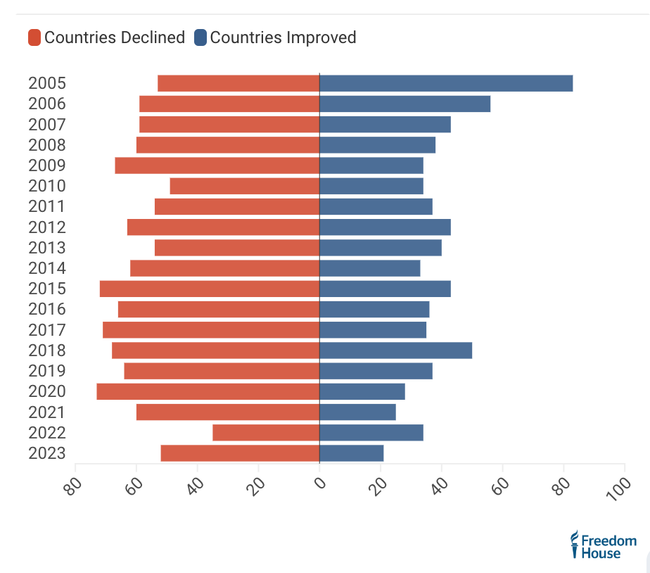
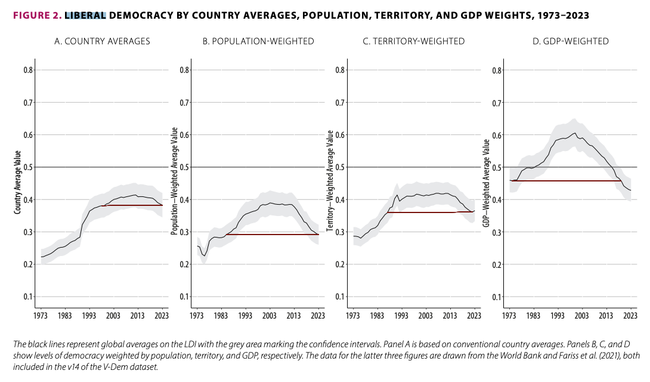
Recent studies have found that the world is facing a decline in democracy. The think tank Freedom House has recorded a decline in democracy for the 18th year in a row. According to their analysis, 52 countries faced a decline in democracy, while only 21 improved. The V-Dem Democracy report published this year stated that “the level of democracy enjoyed by the average person in the world in 2023 is down to 1985-levels; by country-based averages, it is back to 1998”. They found that today the world now has more closed autocracies than liberal democracies, and that the last time this was the case was in 1995. The Democracy Index of The Economist Intelligence found that 45.4% of the world’s population live in a democracy of some sort, but only 7.8% live in a “full democracy”. They reported that according to their analysis, the average global score fell to its lowest level since the index began in 2006.
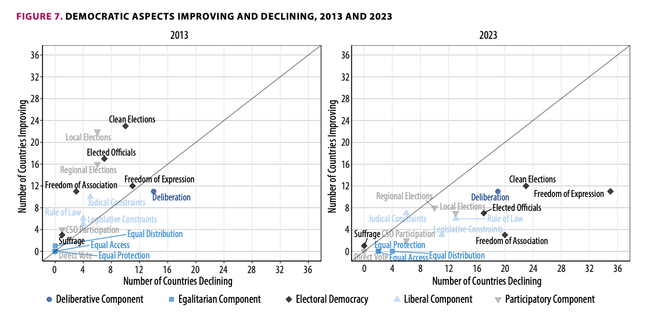
Democracy can be measured by different factors, such as fair elections, freedom of expression, and deliberation. The graph below from the V-Dem report shows an increase of countries declining in respect to these factors compared to those improving. Out of all of the factors, “deliberation is the only component worsening in both panels. It is declining in 19 countries in 2023, compared to 14 in 2013, while improving in eleven countries both in 2013 and 2023. The deliberative component measures respect for opposition, pluralism, and counterarguments with several different indicators and is central to the democratic process”.
Freedom House found that attacks on pluralism were among the main reasons for the decline in democracy. They define pluralism as “the peaceful coexistence of people with different political ideas, religions, or ethnic identities”.
It is true that the global averages could be weighed down by some specific nondemocratic countries. However, in the increasingly globalized landscape we are living in, countries are now more economically interdependent than ever. According to the Wall Street Journal, the initiative of “change through trade”, which aimed to increase shared values through international trade, actually benefited countries such as China and Russia, and allowed them to become even more “radical and undemocratic”, while making western democracies more economically dependent on these nondemocratic countries (Dopfner, 2023).
Looking specifically at democracy in Spain, experts have said that “Spain may well be the most impressively democratic major country in mainland Europe” (Reid, cited by Varadarajan, 2023). Although the political situation is not without its struggles, Reid says that “Spain's politics are no more unkempt than the present Western norm”, and Freedom House classified it as “free”, with a score of 90/100 in their “Freedom in the World” report of 2024. The ideals at the core of democracy remain popular in Spain and the rest of Western Europe, making them part of the global median of 66% who believe that direct democracy is a good way to govern.
These claims of freedom and democracy are not however in line with the perception of Spanish citizens, because another study by Pew Research Center found that large majorities in Spain are dissatisfied with how democracy is working in their country. This makes it part of the 51% of the 27 countries they polled who are dissatisfied with the state of democracy in their country, compared to 45% who are satisfied. Dissatisfaction with democracy is influenced by factors such as people’s perceptions of their politicians and the economic situation in the country, as well as others such as partisanship, because those who support parties that are not currently in power are more likely to say they are dissatisfied with democracy in their country. This last factor is important to note in the increasingly polarized political landscape of the world. Another factor they cited as important to satisfaction with democracy is the freedom of speech. “In every nation studied, dissatisfaction with democracy is more common among people who say the statement ‘the rights of people to express their views in public are protected’ does not describe their country well.”
Scholars such as Little and Meng insist that democracy should be measured based on quantifiable factors, which are not susceptible to individual bias. They state that studies that claim that the state of democracy rely too much on subjective indicators, such as experts using their own judgment to rate the extent to which an election was free and fair (Little & Meng, in Willick, 2024).
2. The Risks of Disinformation
The World Economic Forum (WEF) ranked misinformation and disinformation as no. 1 in their 2024 Global Risk Report. This risk rose to the top of the rankings because of the increase in AI generated false information. Their survey of 1,500 policy makers and industry leaders found that fake news written and being spread by AI was the biggest short-term risk to the global economy. AI was also labeled as an “emerging risk” by the Financial Industry Regulatory Authority (Finra) (Vynck & Lynch, 2024). Policy makers are struggling to keep up with the regulation of the rapid development of technology, and to support innovation while at the same time reduce their potential harm (Ye Hee Lee, 2023).
A 2022 study by UTECA and the University of Navarra found that 95,8% of Spaniards believe that disinformation is a problem in current society. In the survey they conducted, 72,1% of Spaniards recognized that they had believed a message or video that turned out to be false once. The risk of disinformation is one that is rapidly growing, especially in recent years. The same study found that 83,3% of the Spanish population believes that the spread of disinformation has increased first during the pandemic, and again with the war in Ukraine.
Although media companies are adapting to create more content online, and it appears that digital media is going to be the future of the industry, people seem to find more credibility in traditional media. In the study, 80,9% of Spaniards agree that television, radio, and print media provide the best guarantee against the proliferation of disinformation. This does not mean that the diversity of new media sources is only viewed negatively however, as seen in the statistic that 86,6% of Spaniards believe that thanks to the diversity of news programmes, they have a more pluralistic view of society.
Misinformation and disinformation threaten “the cohesion of societies”, by increasing distrust, and which could lead to increasing polarization. The WEF considers societal polarization and misinformation and disinformation to be the two most closely linked risks in their framework, stating that they have the largest potential to amplify each other compared to other risks. The study conducted by UTECA and UNAV found that 91% of Spaniards believe that disinformation is a threat to democracy and the stability of a country.
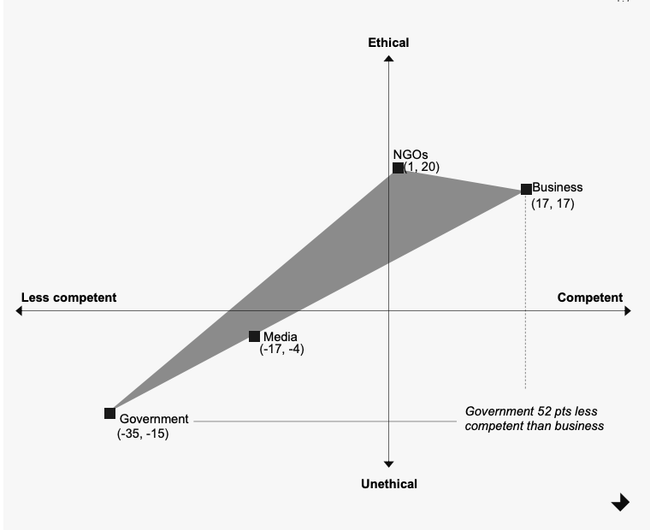
When people are not sure what information is true, they do not know what institutions they can trust. This is evident in the results of the 2024 Edelman Trust Barometer, which reports that businesses are seen as the only trustworthy institution. This study links trust to competence and ethics, and it found that government is seen as far less competent and ethical than business. It was ranked as 52 points less competent and 32 points less ethical. This is in line with other studies on this topic, such as one conducted by the Pew Research Center which found that “only 17% of Americans trust officials in power in Washington to do the right thing” (Pew cited by Eddy in the NYT, 2023).
“It is lack of confidence, more than anything else, that kills a civilisation… We can destroy ourselves by cynicism and disillusion, just as effectively as by bombs.” (Clark, 1960 cited by Luce, 2024, FT)
It is worth noting however, that although business is the most trusted as an institution, business leaders are not seen as trustworthy. The Trust Barometer shows that 61% of people worry that business leaders are “purposely trying to mislead people by saying things they know are false or gross exaggerations”. This shows that the majority believe that business leaders could actually be contributing to disinformation. However, they are still perceived as better than government leaders (63%) and journalists (64%) in this indicator.
Despite this apparent distrust in business leaders, there are high expectations for them in terms of information and ethics, and a demand for them to start playing a bigger role in society. According to the same Edelman report, 62% of employees expect their CEOs to manage changes occurring in society, not just those occurring in their business. Employees believe it is important that their CEOs speak publicly about issues such as “job skills of the future” (82%), “ethical use of technology” (79%) and “automation impact on jobs” (78%). This is especially evident in younger generations. Businesses are starting to realize their role as a “collective stabilizing force in helping ensure that the norms of democracy are upheld” (Levine cited by Eddy, 2023).
Disinformation can also be used as a tool for control in the political sphere. The decline of liberal democracy and the weakening of checks and balances in governments could also be considered a factor that could amplify disinformation in pursuit of political agendas (WEF, 2024). The WEF stated that it is especially a risk in 2024 because of the threat it poses in the many elections set to take place this year worldwide, which makes disinformation both a consequence and cause for the decline in democracy.
3. The Risks of Polarization
Societal polarization was in the top 3 short term risks, and the 9th in long term risks in the WEF Global Risk report. Their research found that 46% of those surveyed saw it as a risk that could present a material crisis on a global scale in 2024. As mentioned, they also report that disinformation is closely linked to polarization. The Edelman Trust Barometer has been proven a useful source for measurement of these factors, and the 2023 edition was focused on “Navigating a Polarized World”. Polarization was cited as being both the cause and consequence of distrust, because people are more likely to believe in information and trust that which is already aligned with their polarized views, not trusting other perspectives, but these polarized views are also a consequence of a lack of trust. Polarization in society could therefore evolve into not only involving political affiliations, but also having polarized views on reality (WEF, 2024). In Spain, 88,1% are of the opinion that people tend to believe more in messages they receive if they are aligned with their way of thinking. However, only 32.8% admit that in their case they tend to believe information that is aligned with their way of thinking (UTECA y UNAV, 2022).
The increasing polarization is seen in indicators such as the one that found that 53% of respondents believe their country is more divided than it was in the past. The report ranked the different levels of polarization in different countries based on two indicators: being divided and entrenched. A “severely polarized” country is therefore one that is severely divided, with the perception that these divisions cannot be overcome. Spain is one of only 6 countries ranked as “severely polarized”, along with Argentina, Colombia, the US, South Africa and Sweden.
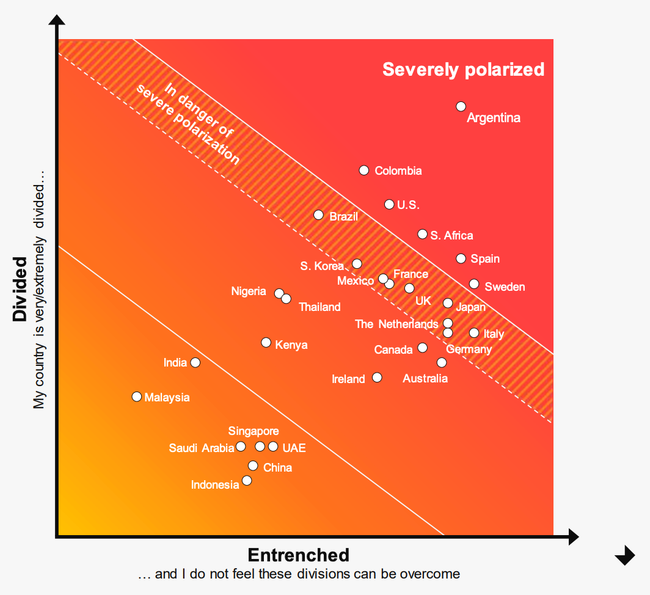
Consistent with their other reports, the 2023 Edelman Trust Barometer also found businesses to be a trustworthy institution, with respondents who feel like they are in a polarized state saying that they only trust business (62%) and their employer (78%). Businesses and leaders therefore “hold the mantle of greater expectation and responsibility”, and have “an essential role to play in the information ecosystem” in advocating for truth and promoting civil discourse.
Polarization is considered a threat to liberal democracy because it has been argued that the polarization of a society makes people more willing to trade off basic democratic principles for their partisan interests (Svolik, 2019). These tradeoffs can include voting for a candidate who belongs to one’s party despite the fact that they exhibit nondemocratic practices. This creates an opportunity for anti-democratic leaders. One example where this trend can be observed is in the United States, where it was found in a study by Graham and Svolik (2020) that most Americans value partisanship more than democratic principles. They say that “most voters are partisans first and democrats only second”, evident in the data that shows that only 13,3% of those who responded to their survey were willing to defect from a candidate from their party for violating democratic principles when the price of doing so is voting against their own party. Their main finding was that “Americans value democracy, but not much”, which is supported by the data that shows that a candidate will only lose 11.7% of his votes for adopting an undemocratic position. Polarization was also found to be associated with higher levels of government intimidation in democracies (Arbatli & Rosenberg, 2020).
4. Technological Risks
4.1. Privacy Risks and Surveillance
The rapid evolution of technology has resulted in it becoming an essential part of everyday life. However, there is a growing concern over privacy and surveillance. For example, a 2019 survey conducted by Pew found that most Americans believe that they cannot go through daily life without their data being collected by either companies or the government.
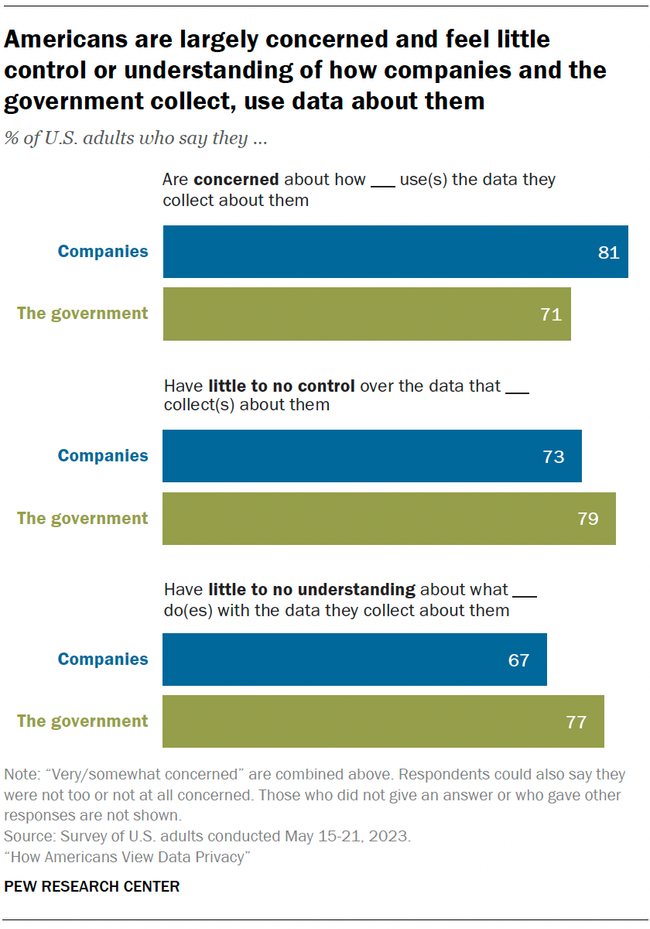
A 2023 version of this survey found that most Americans are concerned and confused about how their data is being used. There is a growing lack of understanding about how companies and the government are using people’s data. In 2019, 59% of Americans claimed that they did not understand how companies are using their personal data, and this figure has risen to 67% in 2023. Similarly, Deloitte found that only 34% believe that companies are clear about how they use the data they collect from online services.
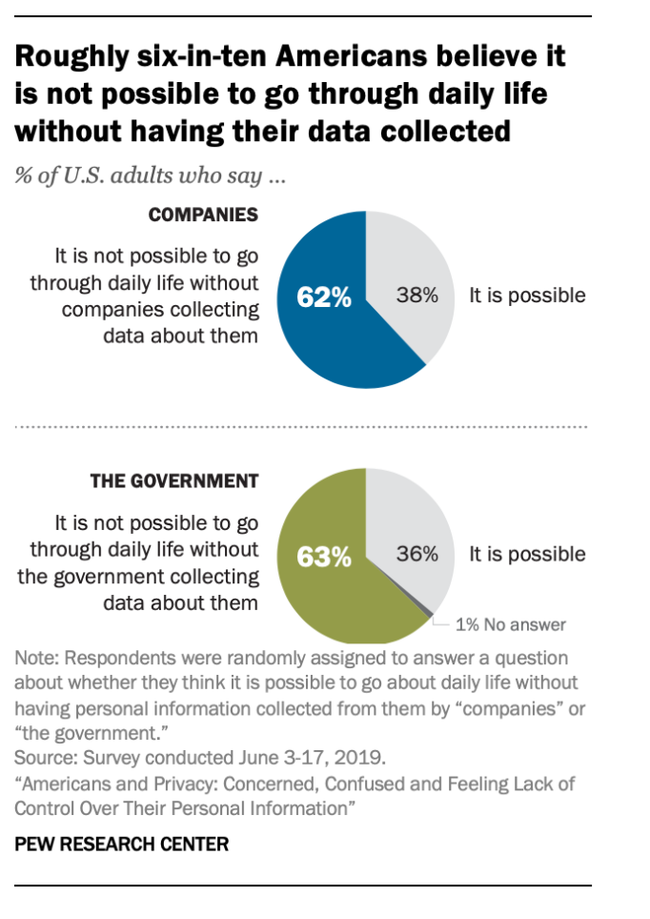
Although they do not understand how their data is being used, it is still a matter of concern to most Americans. The Pew survey found that in 2023, 71% were concerned about how the government uses citizens’ personal data, compared to 64% in 2019. However, more (81%) are concerned about how companies use their personal data. This figure has increased from 79% expressing concern in 2019. This concern was also evident in a 2023 Deloitte report that showed that 67% of smartphone users worry about data security and privacy on their phones, which is up 13% from 2022.
The concern could be linked to the sense of a lack of control with regards to what companies or the government do with people’s personal data. Although the majority exhibit concern and confusion regarding companies using their data, Americans are not all on the same page about whether it is acceptable for companies to use their data. Almost half (48%) believe it is “unacceptable for social media companies to analyze what people do on their sites to deliver personalized content”, but 41% are supportive of it. Similarly, half of the respondents to a Deloitte survey said that they felt that the benefits they get from online services outweigh their data privacy concerns.
When it comes to protecting privacy and data, Americans exhibit more growing confusion. The Pew study found that in 2023, 72% had “little to no understanding about the laws and regulations that are currently in place to protect their data privacy”, compared to 63% in 2019. With regards to managing their own privacy online, 78% of Americans trust themselves to make the right decisions about their personal information, although 61% do not believe that anything they do will make a difference. Deloitte reported that 41% of their respondents believe that it has become easier to protect their online data in the past year.
When it comes to protecting privacy and data, Americans exhibit more growing confusion. The Pew study found that in 2023, 72% had “little to no understanding about the laws and regulations that are currently in place to protect their data privacy”, compared to 63% in 2019. With regards to managing their own privacy online, 78% of Americans trust themselves to make the right decisions about their personal information, although 61% do not believe that anything they do will make a difference. Deloitte reported that 41% of their respondents believe that it has become easier to protect their online data in the past year.
Current privacy laws are mostly based on the “notice-and-choice” or “notice-and-consent” model. The result of these laws are banners and notifications that contain a link to a lengthy privacy policy or terms and conditions document, which Kerry (2020) calls a meaningless “charade of consent”. With regards to this, Pew found that 56% of Americans say they “always, almost always, or often click ‘agree’ right away, without reading what privacy policies say”.
Privacy concerns go beyond data being collected online by companies or the government, and has to do with the emergence of AI as well. The development of AI requires data to be fed to its machine-learning algorithms, which raises concerns regarding the management of this data. “Where is this data coming from? Where is this data stored? Who can access it? And under what circumstances? These are questions that traditional data protection laws are not equipped to answer” (Reuters, 2023). A study from Brookings states that “As artificial intelligence evolves, it magnifies the ability to use personal information in ways that can intrude on privacy interests by raising analysis of personal information to new levels of power and speed”. These factors lead to a sense of distrust with regards to the development of AI.
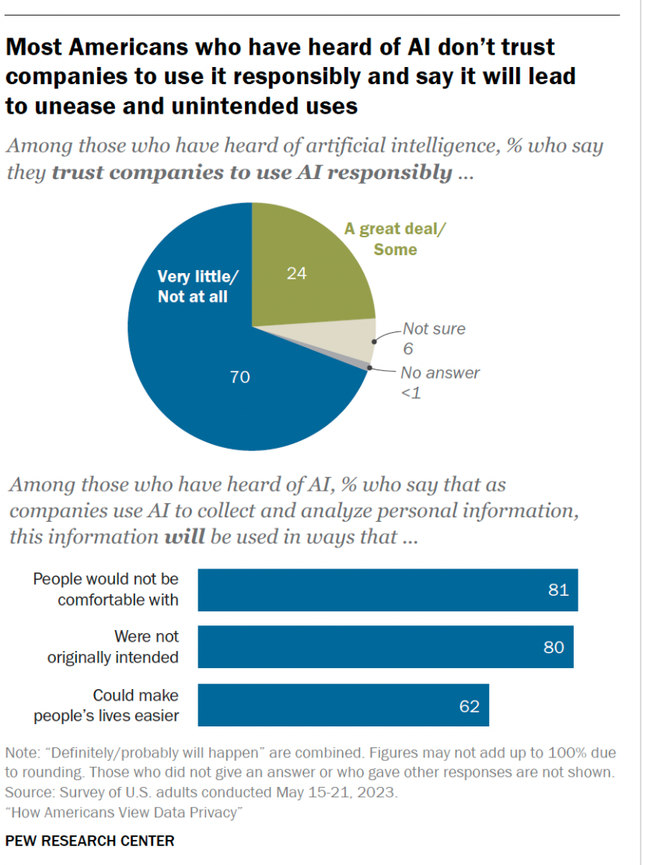
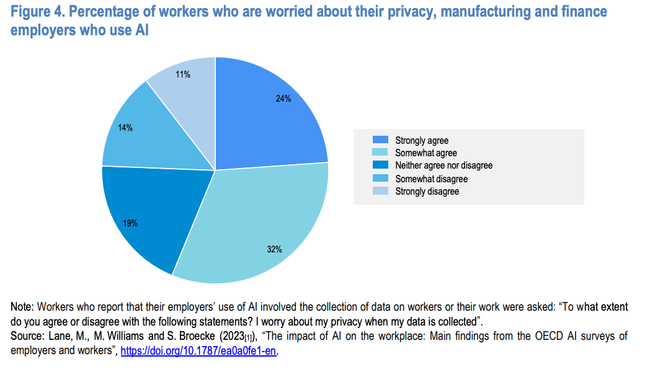
Privacy concerns regarding AI can also be found in the workplace. A survey that the OECD directed at both workers and employers found that when AI is used in the workplace, and workers’ data is used to train the machines, workers are concerned for their privacy. This concern could be related to the nature of the data that is being collected, which may or may not be personal, but also to an increase in monitoring and surveillance in the workplace.
To combat these risks, there is a need for the development of AI to be accompanied by regulations and ethical guidelines, however, it is developing so quickly that it is hard for legislation to keep up. Policymakers, technology developers and the public have to maintain sustained engagement and dialogue regarding AI’s impact on data privacy, and this dialogue is going to shape the future of AI-driven data processing and its impact on privacy rights (Reuters, 2023).
4.2. AI Risks
Artificial intelligence poses more risks beyond data privacy. Chief Risk Officers surveyed by the World Economic Forum showed concern about the risks and regulations regarding AI. About 75% of the CROs said that AI poses a reputational risk to their organization, and 90% believe that more should be done to regulate the development and use of AI. One of the biggest risks that the CROs identified was the “malicious use of AI”, which includes using it to spread misinformation or access personal data. The WEF report said that AI is a serious risk because of its “opaque inner workings”, which means that very few fully understand how AI content is created, which could lead to the risk of sharing personal data or biases in decision-making based on AI algorithms.
It has been proven that AI algorithms can contain biases towards certain groups. For example, in the U.S., judges have used automated risk assessments to determine bail and sentencing limits that have resulted in longer prison sentences or higher bails being imposed on people of color (Lee et al., 2019). The report “Missing Links in AI Governance” published by UNESCO cites other examples, such as OpenAI’s GPT-3 exhibiting a negative bias towards Muslims, as well as race and gender-related biases. The report states that GPT-3 powers over 300 applications in different industries, which means that the biases it contains can have serious effects.
The presence of biases in algorithms stems from how the algorithm is designed. An article published by the European Parliament states that “the results that AI produces depend on how it is designed and what data it uses. Both design and data can be intentionally or unintentionally biased”. Two of the main causes of algorithmic bias are historical human bias, and incomplete or unrepresentative data (Lee et al., 2019). Historical human biases that are factored into an AI model will result in the AI making the same incorrect judgements that people make. With regards to the data that is imputed to train the algorithm, if it is more representative of some groups than others, it could influence the algorithm to make predictions that are worse for the under-represented groups.
The Unesco report “Missing Links in AI Governance” identifies three shortcomings of ethics in AI. The first is a lack of fairness definitions, the second is the lack of diversity, and the last is a lack of ethical standards. Making algorithms more fair would require fairness to be described mathematically, but doing so is a very complicated task, because fairness can have different definitions depending on the problem at hand. The lack of diversity is a clear problem in the design of AI, and Arisa Ema says “who is discussing it cannot be irrelevant to what is being discussed”. AI systems require diversity in both data and human resources at all stages of development in order to ensure quality and accuracy. Lastly the lack of universal ethical standards created a vacuum wherein “industry players are both defining and enforcing their own ethical norms”.
Biased AI systems are a threat to democracy because it could create echo chambers that can further entrench people in their biases and prejudices. This is a threat that was acknowledged by the European Parliament, because the creation of echo chambers does not allow for a “pluralistic, equally accessible and inclusive public debate”, which could lead to further polarization. A study from psychologists at Deusto claims that not only does AI get biases from human data, but people can also inherit biases from AI, which risks getting stuck in a vicious cycle.
In order to address this power vacuum and lack of universal ethical standards for AI, UNESCO started the Global AI Ethics and Governance Observatory which aims to provide resources for policymakers, regulators, academics, the private sector and civil society to face the challenges brought about by artificial intelligence. These resources include the recommendations for ethics in AI which states that “in no other field is the ethical compass more relevant than in artificial intelligence”, because these new technologies are “re-shaping the way we work, interact, and live”. The Recommendations are comprised of values and principles that must be considered in AI, followed by a layout of 11 different areas of policy action, and lastly recommendations on monitoring and evaluation. The four core values UNESCO promotes are 1) human rights and human dignity, 2) living in peaceful, just and interconnected societies, 3) ensuring diversity and inclusiveness, and 4) environment and ecosystem flourishing. These values, along with the 10 core principles provide the basis for their 11 key areas for policy actions, which are more practical strategies that member states can adopt to regulate the development of AI.
Another authority that aimed to tackle the lack of regulation and ethics in AI development is the European Union. In 2019, a High-Level Expert Group of AI released the “Ethics Guidelines for Trustworthy Artificial Intelligence”. These guidelines consist of 7 key requirements that AI systems need in order to be considered trustworthy. These requirements are: 1) human agency and oversight, 2) technical robustness and safety, 3) privacy and data governance, 4) transparency, 5) diversity, nondiscrimination and fairness, 6) environmental and societal well-being, and 7) accountability.
5. Impact on Business
“A vacuum of moral authority has been created by the lessening influence of cultural institutions and the widespread distrust of governmental agencies. Employees are rightfully turning and yearning for leaders with the courage to use their influence to stand up to those acting with seeming impunity.
The challenge though is that the cost-benefit analysis approach many executives are taught in business school doesn’t serve them well in this arena. Cost-benefit analysis does not scale and can prove an executive rather fickle when the winds change as they so rapidly do and have been.
Today’s executives, confronted with navigating difficult social and societal issues, need to develop frameworks for decision-making that are rooted in their organization’s values and purpose. These frameworks can help leaders decide when and how to lean into the issues most relevant to their organizations, foster a shared starting point for conversations, and continue to make progress aligned with their purpose, however non-linear that progress might be.”
Increasing economic globalization means that relationships with other countries are not only the concerns of politicians, but also of business executives and decision makers. The current trends and demands for ethics and sustainability in business must consider the risks not only for their business, but for the state of democracy in the world. As Dopfner puts it: “The CEO who makes virtuous speeches about ESG standards in the morning and then shifts a bit more of the company's production to China or Russia in the afternoon should decide for one of the two”.
An article from the think tank Brookings stressed the importance of business leaders being better informed about the relationship between economics and democracy, as well as the role they play in safeguarding democratic institutions (Williamson, 2024).
Do you like what you are reading? Subscribe to receive updates.
Unsubscribe anytime