
Abstract
The UN Sustainable Development Goal “Life on Land” is addressing critical concern in environmental sciences about the growing threats of desertification and land degradation from wildfires and other natural disasters. Virtual Reality can play a significant role in planning and displaying a resolution to these issues. Currently, there is a lack of successful real-time interactive models to aid natural disaster management, often leading to unpredicted outbreaks, causing unprepared individuals and citizens to be impacted. Virtual Reality can aid better preparation methods regarding unpredictable wildfires, allowing for all to be ready for contributing to resolutions. To address these concerns, I designed the virtual reality project “Why Must We Make it All Burn?” with the use of 3D typography and hypertext, challenging viewers to confront the human-driven causes of environmental destruction and prompts a critical examination of our role in global ecological crises. Through sketching, storyboarding, creative coding, 3D modeling, design, programming the interactions, special effects, spatial audio, and final testing, this project was developed using Unity Game Engine and C# programming language. The project was exhibited in the CAVE2 VR environment [1], in the University of Illinois, Chicago. The exhibition was attended by 25 people. The audience was immersed in the land of deforestation, among the endless fields of trunks and trees consumed by flames, was an edifying immersive experience for the public. The project motivated my audience to learn more about deforestation and environmental protection. I successfully designed and developed an immersive project that uses Virtual Reality to contribute to environmental engineering, as well as including 3D models of symbolic typography to immerse the audience more. This work will be featured in a special CAVE2 VR exhibition proposed for the Hypertext 2025 Conference, where participants can navigate an interactive VR environment connecting scenes of fire and deforestation through hypertextual typographies.
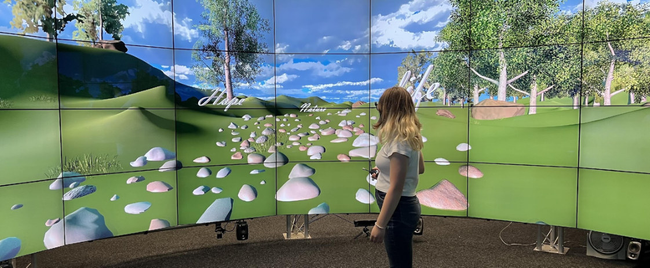
Participants follow 3D typography that functions as a hyperlink, guiding them through the original VR environment scene.
Introduction
The UN Sustainable Development Goal “Life on Land” is addressing critical concern in environmental sciences about the growing threats of desertification and land degradation from wildfires and other natural disasters [2].
Virtual Reality can play a significant role in planning and displaying a resolution to these issues. Currently, there is a lack of successful real-time interactive models to aid natural disaster management, often leading to unpredicted outbreaks, causing unprepared individuals and citizens to be impacted [3,4,5]. Virtual Reality can aid better preparation methods regarding unpredictable wildfires, allowing for all to be ready for contributing to resolutions.
To address these concerns, I designed the virtual reality project “Why Must We Make it All Burn?” with the use of Creative Coding with C#, Unity game engine, and 3D typography, challenging viewers to confront the human-driven causes of environmental destruction and prompts a critical examination of our role in global ecological crises.
The addition of interactive typography gives the viewer a more hands-on experience, reflecting the direct message of the project. That the hands-on actions of humankind resulted in the deserted and wasteland-like field of negativity.
This project was created for exhibition in the CAVE2 VR Environment as part of the Creative Coding Community Workshop at the Electronic Visualization Laboratory (EVL), in the University of Illinois Chicago [6].
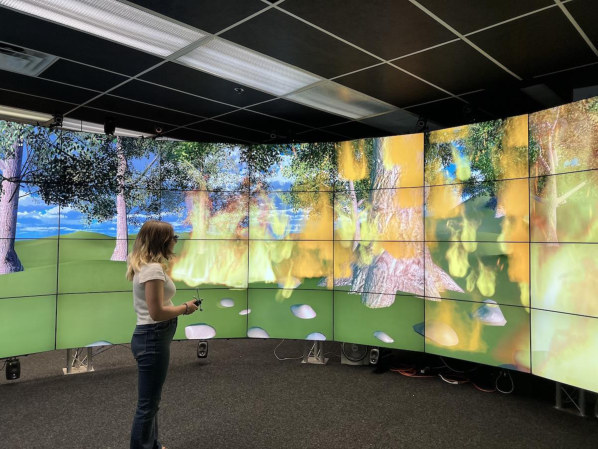
A participant engaged in the VR experience, encountering a scene that visualizes the environmental impact of human activity.
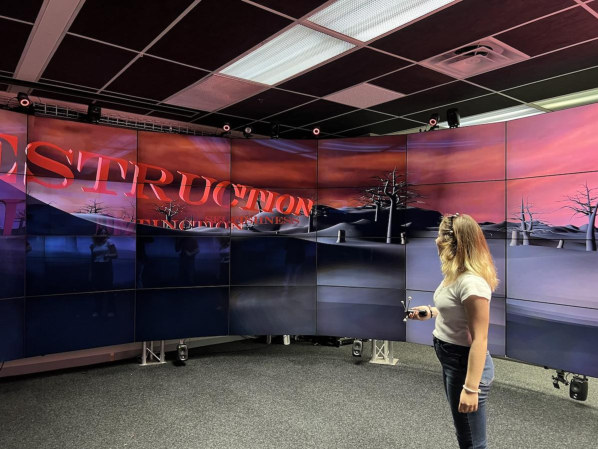
Participant engaging with 3D typography in the VR experience, which illustrates the environmental consequences of human actions.

Participants engaged in an exhibited display of the VR scenes and typography.
I hypothesize that the addition of typography and hypertext within Virtual Reality can support the development and evaluation of creative solutions for environmental health by providing interactive and immersive, yet straight-to-the-point experiences, inspiring empathy and deeper engagement with the consequences of human behavior.
VR Project and Exhibition
In response to the UN Sustainable Development Goal “Life on Land,” this project advocates for the urgent need to protect and sustainably manage forest eco- systems, while addressing the growing threats of desertification and land degradation.
Through the impactful use of 3D typography, “Why Must We Make It All Burn?” challenges viewers through interactive hypertext to confront the human-driven causes of environmental destruction and prompts a critical examination of our role in global ecological crises. This project calls for reflection and action in the face of an increasingly imperiled natural world.
The exhibition was attended by 25 people and followed by a thoughtful discussion and reflection, during which participants shared their responses to the immersive experience.
Interactive typography in this project serves both as a narrative guide and a structural framework, drawing on a range of precedents in immersive and typographic storytelling. A key influence is What Remains of Edith Finch [7], in which text is seamlessly embedded within a 3D environment, unfolding dynamically as the player progresses through the story. Similarly, this VR exhibition employs spatialized typography and interactive screenplay to guide the viewer through a layered narrative experience. Another important reference is Jeffrey Shaw's Legible City [8], where architecture is replaced by text, enabling users to navigate virtual cities composed entirely of language. The use of imposing typographic structures in this VR exhibition—particularly in the deforestation scene—was directly inspired by the architectural typography in Legible City. Building on these examples, the project explores hypertextual and spatial techniques that position language not only as narrative content but as an active, immersive medium through which the viewer journeys.
The viewer is brought upon a path among a shimmering forest filled with welcoming text, such as “peace”, “hope”, and “love” leading the way. As the viewer reaches the end of the path, they are met with a forest of lush trees and large, bold text stating: “BURN IT ALL”. By reaching a certain vicinity of the text, it acts as a hyperlink, triggering fire to grow around the viewer, engulfing them and the previously lush forest, in flames. As the fire ravishes, with the sounds of wood crackling and burning, the viewer is brought forth into another scene, among endless dark fields of tree trunks. Symbolizing the aftermath of the actions taken by the viewer, text then appears boldly on the path, such as “Destruction”, “Extinction”, and “Selfishness”. The viewer follows the path, reflecting on the real consequences of deforestation. Then are immersed in the consequences that humankind has on the environment, specifically, deforestation. Finally, as they reach the very end of the pathway, the viewer is transported to an all-dark scene, with a singular typographic phrase; “Why must we make it all burn?”. This final phrase focuses on visualizing the growing threats of desertification and land degradation resulting from wildfires and natural disasters.
The design and development of his project reflects my success in creating an immersive project that utilizes typographic components, Virtual Reality, and Creative Coding to contribute to environmental engineering.
CONCLUSION
My hypothesis was proven true, as the immersion of Virtual Reality and interactive typographic components gave the audience a long-lasting and impactful impression of the results of deforestation. Virtual Reality can be a powerful tool to preview environmental engineering solutions to protect our environment and impact more individuals to come. As well as interactive typography and hyperlinked text acting as symbolic and explicit orders to the viewer regarding calls for action.
Acknowledgments
The project was made possible with support from the Electronic Visualization Laboratory (EVL) and Creative Coding Community Workshop of the University of Illinois Chicago.
References
[1]Febretti, A., Nishimoto, A., Thigpen, T., Talandis, J., Long, L., Pirtle, Jd., Peterka T., Verlo, A., Brown, M., Plepys, D., Sandin, D., Renambot, L., Johnson, A., And Leigh, J. 2013. Cave2: A Hybrid Reality Environment For Immersive Simulation And Information Analysis. In Proc. Spie 8649, The Engineering Reality Of Virtual Reality 2013, 864903.
[2]United Nations. The sustainable development goals. Retrieved June10, 2025, fromhttps://sdgs.un.org/#goal_section
[3]Jeremy Bailenson and Rob Jordan. Virtual reality could serve as powerful environmental education tool, according to Stanford researchers. Stanford Report. November 30, 2018. Accessed on April 2, 2025.https://news.stanford.edu/stories/2018/11/virtual-reality-aids-environmental-education
[4]The European Space Agency. ESA's Digital Twin Earth programme: building a virtual model for a changing planet. Accessed on April 2, 2025.https://www.esa.int/Applications/ObservingtheEarth/ESAsDigitalTwinEarthprogrammebuildingavirtualmodelforachangingplanet
[5]Bauer, P., Stevens, B. & Hazeleger, W. A digital twin of Earth for the green transition. Nat. Clim. Chang. 11, 80–83 (2021).10.1038/s41558-021-00986-y
[6]Tsoupikova, Daria, and Jeff Nyhoff. "Investigating Experimental Design+ Theater+ Coding methodology to teach virtual reality design: a case study: investigating Experimental Design+ Theater+ Coding Methodology." In ACM SIGGRAPH 2022 Educator's Forum, pp. 1-2. 2022.
[7]Giant Sparrow. (2017). “What remains of Edith Finch” [Video game]. Annapurna Interactive.
[8]Shaw, Jeffrey. The Legible City. 1989, Jeffrey Shaw Compendium, Accessed on July 9, 2025.https://www.jeffrey-shaw.net/html_main/show_work.php3?record_id=43.
Do you like what you are reading? Subscribe to receive updates.
Unsubscribe anytime